 Vera's Roofing
Vera's Roofing does free roof inspections in Caswell Beach and across Brunswick and New Hanover counties, and every inspection includes photos and notes. Call (910) 228-8034 or request a free roof inspection.
Salt air does wear on roof metal, and it works hardest close to the surf. On a beach roof, we look first at the flashing where the roof meets walls and chimneys, the roof edges, and the nails and screws holding everything down. Below is why, what we check, and when it's worth booking.
Why salt air is hard on roof metal
Corrosion researchers have found that the ocean's effect on steel is strongest within a few hundred meters of the shoreline and drops off quickly farther inland.
A 2026 eight-year outdoor study in Brittany, France (LeBozec and Thierry, Materials and Corrosion) put factory-painted galvanized steel at sites from a few meters to about 40 km from the sea. Paint blistering decreased as sites got farther from the sea, and how fast corrosion crept under the paint from cut edges depended on how corrosive the site was.
Caswell Beach sits on the Atlantic at the mouth of the Cape Fear River, on the east end of Oak Island, and its homes face open-ocean wind. Over time, salt air and strong sun wear on metal parts, coatings, sealants and exposed details. How the roof looks matters more than how old it is.
What we check on a Caswell Beach roof
- Flashing at walls, chimneys and transitions. North Carolina's residential code requires flashing where a roof meets a wall, wherever the slope or direction changes, and around roof openings. Metal flashing must be corrosion resistant and at least 0.019 inch thick (No. 26 galvanized sheet). Water can get in around flashing, walls and transitions even when the middle of the slope looks fine from the ground.
- Roof nails. The same code calls for galvanized steel, stainless steel, aluminum or copper nails on asphalt shingles. GAF notes that stainless steel nails are typically used where corrosion is very likely, most commonly in coastal regions, and that salt spray can damage aluminum nails.
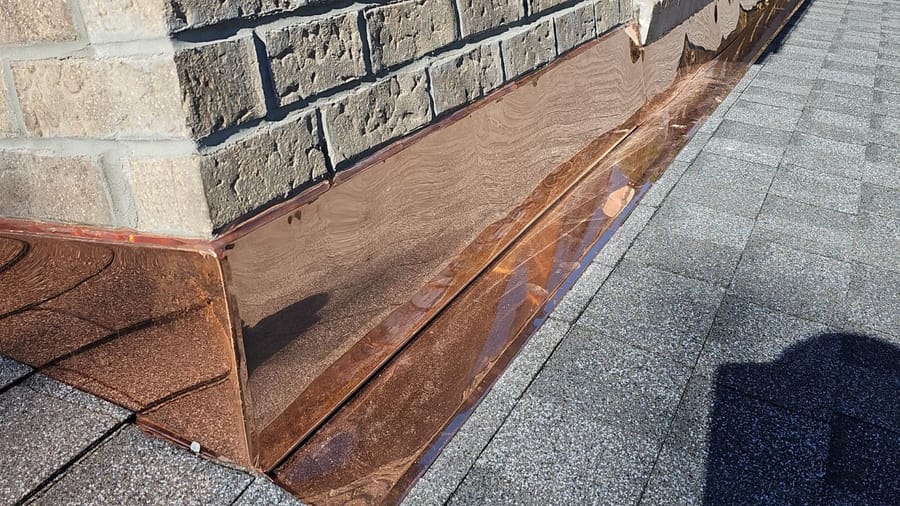
- Mixed metals. GAF also warns that mixing galvanized nails with copper can cause a galvanic reaction that leads to corrosion in both, and calls it best practice to use nails of the same material as copper flashing. Where metals meet, the materials have to be compatible. See our metal roofing and copper flashing service.
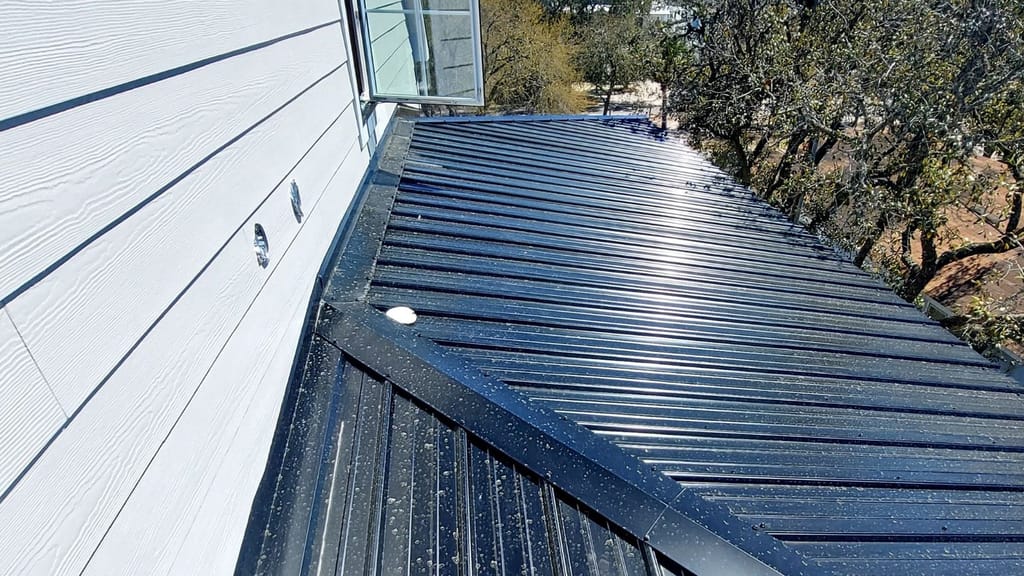
- Metal panels and their fasteners. The code points to the panel maker's installation instructions. Without them, galvanized fasteners are required for steel roofs, and stainless steel fasteners are acceptable for metal roofs. For painted metal panels, we recommend 26-gauge minimum for wind and corrosion resistance.
- Edges, ridges, sealants and vents. Open exposure is harder on roof edges, ridges, flashing, fasteners, sealants and drainage. If a leak traces to a vent or pipe boot, see our roof vent leak repair page.
You can read how our roof inspection works before you book.
Many Caswell Beach homes are seasonal or for rent
Census Bureau estimates for 2020-2024 show, for the Town of Caswell Beach:
- about 675 housing units, with a median year built of 1998
- about half built between 1980 and 1999, and about 4 in 10 built from 2000 to 2009
- about two in three housing units counted as vacant when surveyed, nearly all of them seasonal homes or homes for rent
If you're only at the beach part of the year, nobody may be around to notice a new stain or a piece of trim that's worked loose. That's what the photos and notes are for. We send them to you, so you can see what we saw. For a second home or rental, tell us how to get in and when guests are there, so we can plan the visit.
Permits in Caswell Beach
Caswell Beach has been an incorporated town since 1975. The town code creates its own inspection department and requires permits for building work, a permit technician works out of Town Hall, and the town has adopted the North Carolina State Residential Building Code. Whether a roof job needs a permit depends on the work, and we handle permits when they're required.
When to book a roof inspection
The National Roofing Contractors Association recommends roof inspections at least twice a year, preferably in spring and fall, and after severe weather such as a hurricane, tornado or hailstorm. The Atlantic hurricane season runs June 1 to Nov. 30.
From the ground, watch for missing or lifted shingles, new stains on a ceiling, flashing that has moved, or gutters spilling over in the rain. Please don't climb onto the roof to check. That's what the inspection is for.
If a storm just came through, our guide to checking a roof after a storm covers what you can safely look at. If you're weighing materials for a beach house, read metal roof vs. shingles on the NC coast. More on the island is on our Oak Island roofing page and the Caswell Beach section of our Brunswick County page.
About Vera's Roofing
- Family-owned and insured. We're a family-owned roofer, and we carry workers' comp and general liability insurance.
- Shingles and metal. We install CertainTeed and GAF 30-year shingles. For metal, we offer 5-V, Multi-Rib and standing seam, painted, 26-gauge minimum.
- Warranty. Installs come with our one-year labor-and-materials warranty plus the manufacturer warranties.
- Permits and tarping. We handle permits when they're required, and we tarp roofs when it's needed.
- A verifiable credential. Vera's Roofing is a FORTIFIED Roofer, provider ID R012048.
You can see more of our work on our project photos page.
Questions about salt air and your roof
Do you do roof inspections in Caswell Beach, NC?
Yes. Vera's Roofing inspects roofs in Caswell Beach and across Brunswick and New Hanover counties. The inspection is free and includes photos and notes.
Does salt air damage roof flashing and nails?
It can. Corrosion research shows the ocean's effect on steel is strongest within a few hundred meters of the shoreline. North Carolina's code requires corrosion-resistant metal flashing and galvanized steel, stainless steel, aluminum or copper roofing nails, and on a beach roof we check flashing, edges and fasteners first.
Can copper flashing be used with galvanized nails?
GAF warns that mixing galvanized nails with copper can cause a galvanic reaction that leads to corrosion in both, and calls it best practice to use nails of the same material as copper flashing. Where metals meet, the materials have to be compatible.
How often should a Caswell Beach roof be inspected?
NRCA recommends at least twice a year, preferably in spring and fall, and again after severe weather such as a hurricane, tornado or hailstorm.